
There’s a specific kind of frustration that transport business owners know well: you’ve done the job, the goods reached safely, and now the client is sitting on payment because “there’s some issue with the invoice.”
Sometimes it’s a genuine dispute. But a lot of the time, the issue is a missing field. An incorrect HSN code. A forgotten vehicle number. A GSTIN that wasn’t verified before the invoice was raised. These aren’t big mistakes — but in GST compliance, small mistakes have big consequences: delayed payments, ITC rejection at the client’s end, and e-invoicing errors that flag your account.
Here is what a legally correct, professionally structured freight invoice for a Goods Transport Agency in India must contain — every single time.
The Basics — Usually Done Right
Most transport invoices get these right: a sequential, unique invoice number with a fresh series from April 1 each financial year; the invoice date; your GSTIN, name, and address; your client’s GSTIN, name, and address for B2B transactions; and the place of supply — which for GTA services provided to a registered recipient is the location of the recipient, not the origin of the goods.
That last one — place of supply — trips up more people than you’d expect. Especially for interstate freight where origin and recipient are in different states.
The Transport-Specific Fields — Usually Missing
This is where freight invoices diverge from regular service invoices — and where most mistakes happen. These fields are mandatory or strongly recommended for every GTA invoice:
Consignment Note Number and Date
This is the legal document that makes you a GTA under GST. Without it on the invoice, you may not qualify as a GTA at all — which changes your entire tax liability picture. Consignor and consignee details must accompany this.
Vehicle Number
Mandatory. Also required for e-way bill matching. If it doesn't match, expect delays.
Origin and Destination
City-to-city, not just states. "Delhi to Mumbai" is correct. "North to West" is not.
Description of Goods
Specific. "Iron rods, 8MT" is correct. "Goods" is not. This field gets checked during audits.
GR Number (Goods Receipt)
Your proof of handover. If a dispute arises about whether goods were delivered, this is the document that decides the outcome.
SAC Code 996511
GTA services fall under SAC 9965. This must appear on your invoice — it is used in e-filing and e-invoicing validation.
Transport Logistic by SoftwareWale generates invoices with all of these fields pre-structured — consignor, consignee, vehicle, GR number, SAC code, GST mode, and live calculation of freight, loading, toll, and GST.
See It in Action →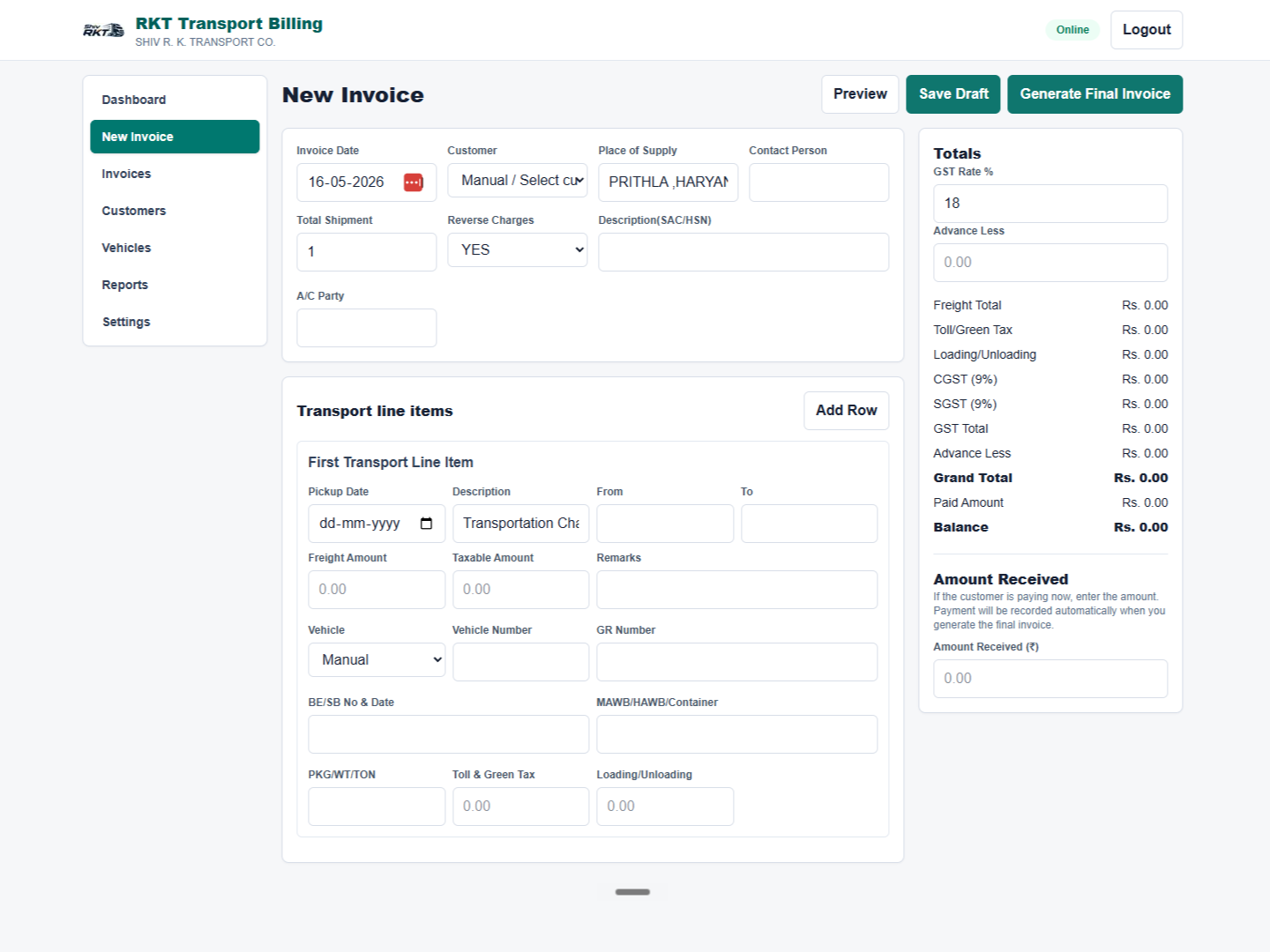
Transport Logistic invoice creation — every mandatory field is built into the form. No missing fields, no rejected invoices.
The Charges Breakdown — Often Unclear
A well-structured freight invoice breaks charges down clearly. Following the 54th GST Council clarification (September 2024): if all these charges relate to the same consignment under the same consignment note, they’re treated as a composite supply and taxed at the same rate as the primary transport service. You can combine them on one invoice — and it’s cleaner to do so.
| Charge Type | Notes |
|---|---|
| Freight charges | Primary transport charge |
| Loading charges | Part of composite supply |
| Unloading charges | Part of composite supply |
| Toll & Green Tax | Show separately for transparency |
| Detention charges | If applicable — state the reason |
| Advance adjustment | Deduct clearly if advance was paid |
The GST Treatment Declaration — Frequently Wrong
This is the field most small transport companies skip or get wrong — and it’s the one that causes the most downstream problems.
Your invoice must clearly state whether GST is being paid under Reverse Charge Mechanism (the default if you haven’t filed Annexure V), or whether you’ve opted for Forward Charge at 18% with ITC. Your client’s accounts team uses this declaration to file their own GSTR-3B correctly. Without it, their filing is wrong, which delays payment and potentially triggers queries.
If you are under RCM (default)
“GST under Reverse Charge — 5% to be paid by recipient. GTA has not opted for Forward Charge for this financial year.”
If you filed Annexure V (Forward Charge)
“GTA has opted for Forward Charge under Annexure V. GST @ 18% charged by supplier.”
The Fields That Protect You Commercially
Beyond compliance, a good freight invoice protects your business.
Payment terms.State them explicitly. “Net 30 days from invoice date” is cleaner than an assumed understanding. You would be surprised how many payment delays happen because there was no stated term.
Bank account details for NEFT/RTGS. Still not standard on many transport invoices. Your client should not need to call you to make a payment.
Jurisdiction clause.One line: “All disputes subject to [city] jurisdiction.” This matters more than people realise once a large consignment goes missing.
What a Complete Invoice Actually Looks Like
Here is a simplified illustration of a correctly structured freight invoice. Not glamorous. But every field is there, every compliance box is ticked, and your client’s accounts team can process it without calling you twice.
FREIGHT TAX INVOICE
Invoice No: TL-2025-0042 Date: 14 May 2025
GSTIN: 07XXXXX1234Z5 SAC: 996511
From: [Your Company Name, Address, GSTIN]
To: [Client Company Name, Address, GSTIN]
Consignment Note: CN-2025-042 LR No: LR-7821
Consignor: [Name] Consignee: [Name]
Vehicle No: DL 7C 1234 Dispatch: 13 May 2025
From: Delhi To: Mumbai
Goods: Electrical fittings, 2.4 MT
CHARGES:
Freight: Rs.12,000
Loading: Rs.800
Unloading: Rs.600
Toll & Green Tax: Rs.500
-----------------------------------
Total (Excl. GST): Rs.13,900
GST: Reverse Charge — 5% payable by recipient.
GTA has not opted for Forward Charge for this FY.
Payment Due: 13 June 2025
Bank: HDFC IFSC: HDFC0001234 A/C: 50100XXXXXX
Large manufacturers, FMCG companies, and multi-state retailers increasingly have internal compliance teams that reject invoices with missing fields. Winning those clients — and keeping them — requires invoices that work on the first submission. Transport Logistic generates invoices like this automatically, with all mandatory fields, live GST calculation, and print-ready PDF output.