
There’s a phrase used by accountants who work with transport companies: paisa road pe hai. The money is on the road.
It refers to freight that’s been delivered, work that’s been done, but invoices that haven’t been raised yet — or raised but not submitted, or submitted but stuck in a client’s accounts department waiting for someone to process them.
For most small transporters in India, this isn’t a cash flow problem in the traditional sense. It’s a documentation problem that becomesa cash flow problem. And it’s remarkably fixable once you see where the delays actually come from.
Where the Money Actually Gets Stuck
Stage 1: The invoice is raised late
In many small transport operations, invoices are raised at the end of the month — or whenever the accounts person gets around to it. The consignment moved on the 3rd. The invoice goes out on the 28th. The client’s payment cycle runs from the 1st. You’ve already missed one full cycle before you even started. Every day of delay on the invoice is a day added to your payment wait. Raise within 24-48 hours of successful delivery. Not at the end of the month.
Stage 2: The invoice is missing something
Client’s accounts team receives the invoice. They check it against the purchase order. Vehicle number doesn’t match. LR number is missing. GST treatment isn’t specified. The invoice goes into a “query pending” folder, and nobody tells you. You follow up in two weeks wondering why payment hasn’t come. They tell you then. Add another 2-3 weeks to the cycle. Five fields take 60 seconds to verify before sending: GSTIN, vehicle number, LR number, consignment note reference, and GST treatment. That check eliminates the most common rejection reasons.
Stage 3: The Proof of Delivery isn’t attached
For any consignment above Rs.50,000 — which is most B2B freight — the client’s accounts team will not process payment without a signed POD or delivery receipt. In many small transport operations, the POD is a paper form that the driver collects, puts in a pocket, and eventually hands to the office days later, crumpled, sometimes unreadable. No POD means no payment processing. One WhatsApp photo of the signed delivery receipt at the moment of handover eliminates this entirely. Free, 20 seconds, makes it the driver’s responsibility.
Stage 4: You’re not following up systematically
Following up on payments feels uncomfortable. It feels like begging. Many small transport operators avoid it until they really need the money, by which time the invoice is 45 days old.
The professional reframe: a payment follow-up is not a request for a favour. It is a confirmation that your contractual obligation is complete and you are checking on the client’s end of the agreement. It is routine business communication.
Invoice sent, confirmation requested
"Checking that the invoice was received and everything is in order"
"Following up on Invoice [number] — due on [date]"
"Invoice due today — please confirm payment date"
Escalate to senior contact if no response
Transport Logistic's Reports section shows every invoice with Paid, Unpaid, and Partially Paid status in real time — so you always know exactly where your money is.
Talk to Us on WhatsApp →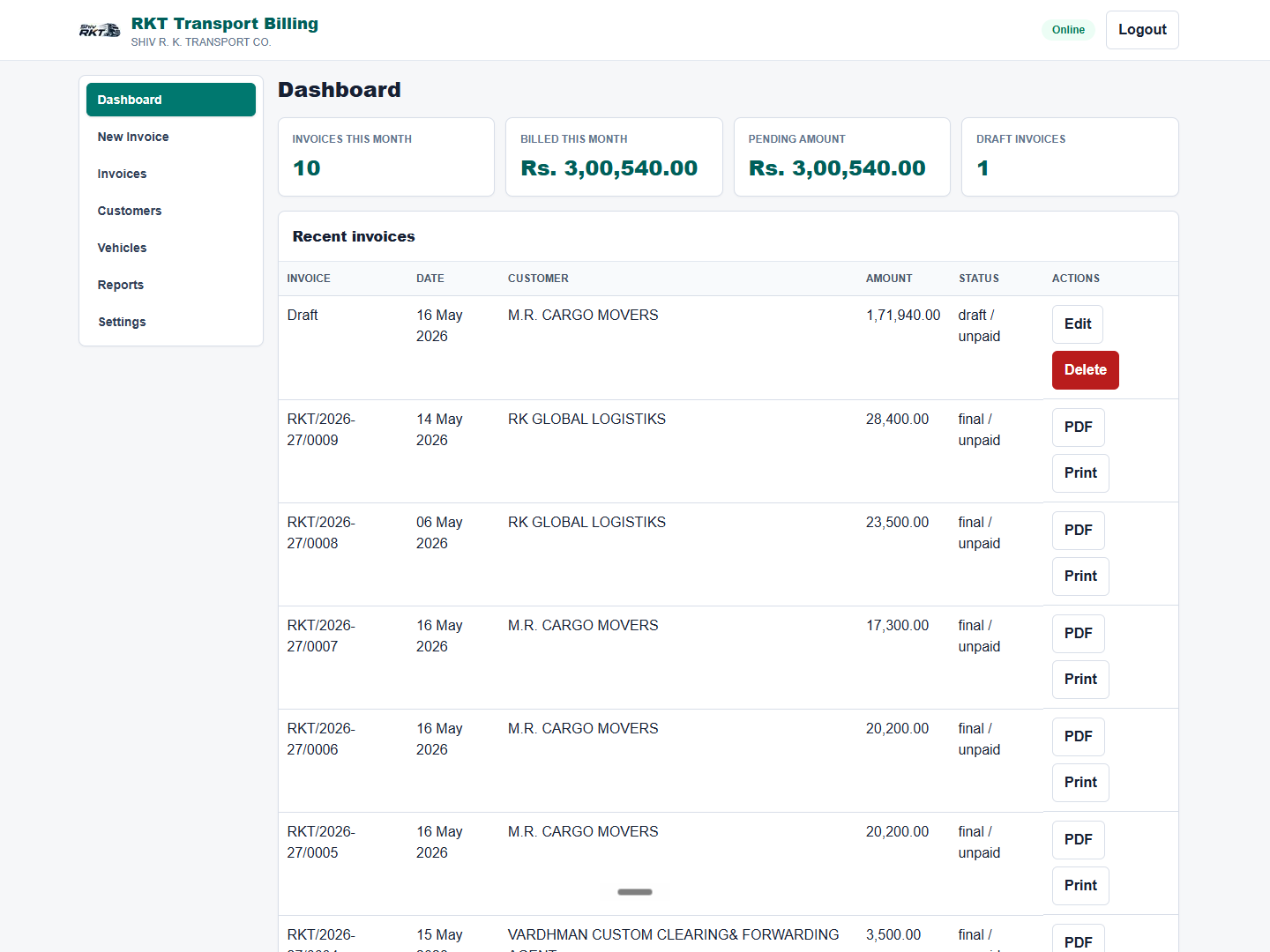
Transport Logistic reports — every invoice with real-time Paid, Unpaid, and Partially Paid status. Outstanding total visible at a glance.
The Hidden Cost of Payment Delays — Calculated
Most transport company owners have never run this number.
Example: 5 trucks, Rs.1.5 lakh average monthly freight per truck
Reduce your average collection period from 60 days to 30 days — through better invoicing discipline and follow-up — and you free up Rs.7.5 lakh in working capital. No bank loan. No new client. Just better paperwork and a follow-up schedule.
The TReDS Option Most Small Transporters Don’t Know About
The Trade Receivables Discounting System (TReDS) — backed by the Reserve Bank of India — is a regulated platform where MSMEs including transport companies can sell their freight invoices to financiers at a small discount and get paid within 1-2 business days instead of waiting 30-90 days.
The math: a Rs.1 lakh invoice your client pays in 60 days can be sold on TReDS for roughly Rs.98,000-99,000 today. You lose Rs.1,000-2,000. You gain 60 days of working capital. For a transport company running tight margins with fuel costs and driver salaries due every week, that trade is often worth it.
The catch: TReDS requires your client to be registered on the platform. Large manufacturers, FMCG companies, and public sector clients are increasingly on TReDS. For smaller clients, private invoice discounting fintechs operate in India with online applications and quick disbursals — search for “invoice discounting MSME India” for current options.
Three Things You Can Start Doing This Week
Create a payment tracker for every active invoice
A spreadsheet with invoice number, client name, amount, date raised, due date, follow-up dates, and status. Review it every Monday. This alone prevents the "I forgot to follow up" situation.
Photograph every POD at delivery
Assign this to your drivers as a non-negotiable. One WhatsApp photo the moment goods are signed for. That is it.
Raise invoices within 48 hours of delivery — not at month-end
This single habit, consistently followed, can reduce your average collection period by 10-15 days over a quarter. If you are using Transport Logistic, the invoice is generated from the same screen where you enter the trip — no separate step.
None of these require software. None require investment. They require discipline — which is harder than money but more valuable.
India’s logistics market is heading toward $357 billion by 2030. The volume of freight invoices being raised, disputed, and delayed will only increase. The transport companies that build billing discipline now will handle that growth structurally better than those that don’t. Start this week. See how Transport Logistic helps →