
If you search “school management software India” right now, you will find dozens of options. Every company says their platform is the best, the most affordable, the easiest to use, and the most trusted.
Most principals walk away from this search more confused than when they started.
This guide is not written to push a particular product. It is written because we have spoken to hundreds of school administrators across India and we keep hearing the same stories: paid for software that was never fully set up, bought a platform that teachers refused to use, or got locked into per-student pricing that became expensive as the school grew.
Here is what to actually look for — and what to be careful about.
Start With the Real Question: What Problem Are You Solving?
Before comparing features, be clear about why you are looking for software. Most schools come in with one of these four reasons:
Attendance is taking too long. Teachers spend 20-30 minutes every morning on paper registers, and the principal has no live view of which classes are marked.
Fee collection is unreliable. Parents delay payments, reminders go on WhatsApp and get ignored, and reconciling monthly collections takes days.
Parent communication is chaotic. Too many WhatsApp groups, important notices buried under replies, parents complaining they did not receive information.
The school looks unprofessional. New parents compare your school with competitors who have an app and find yours is still running on spreadsheets.
Once you know which of these is your main problem, you can evaluate software based on how well it solves that specific thing — not based on how long the feature list is.
The Pricing Trap That Catches Most Schools
The most common pricing model in school software is per-student pricing. On paper it sounds fair: you pay based on how many students you have. But the math works against growing schools.
If you are paying Rs.30 per student per month with 400 students, that is Rs.12,000 per month. When you reach 600 students — a sign the school is doing well — you are suddenly paying Rs.18,000 per month. Your software cost has increased 50% and you did nothing differently.
Good school software should be priced by school size tier, not per student. The cost should be predictable so you can plan your budget without worrying about software expenses rising every time enrolment improves.
Always ask: “If my student count increases by 200 next year, what changes in my monthly cost?”If the answer is “it increases proportionally,” factor that into your decision.
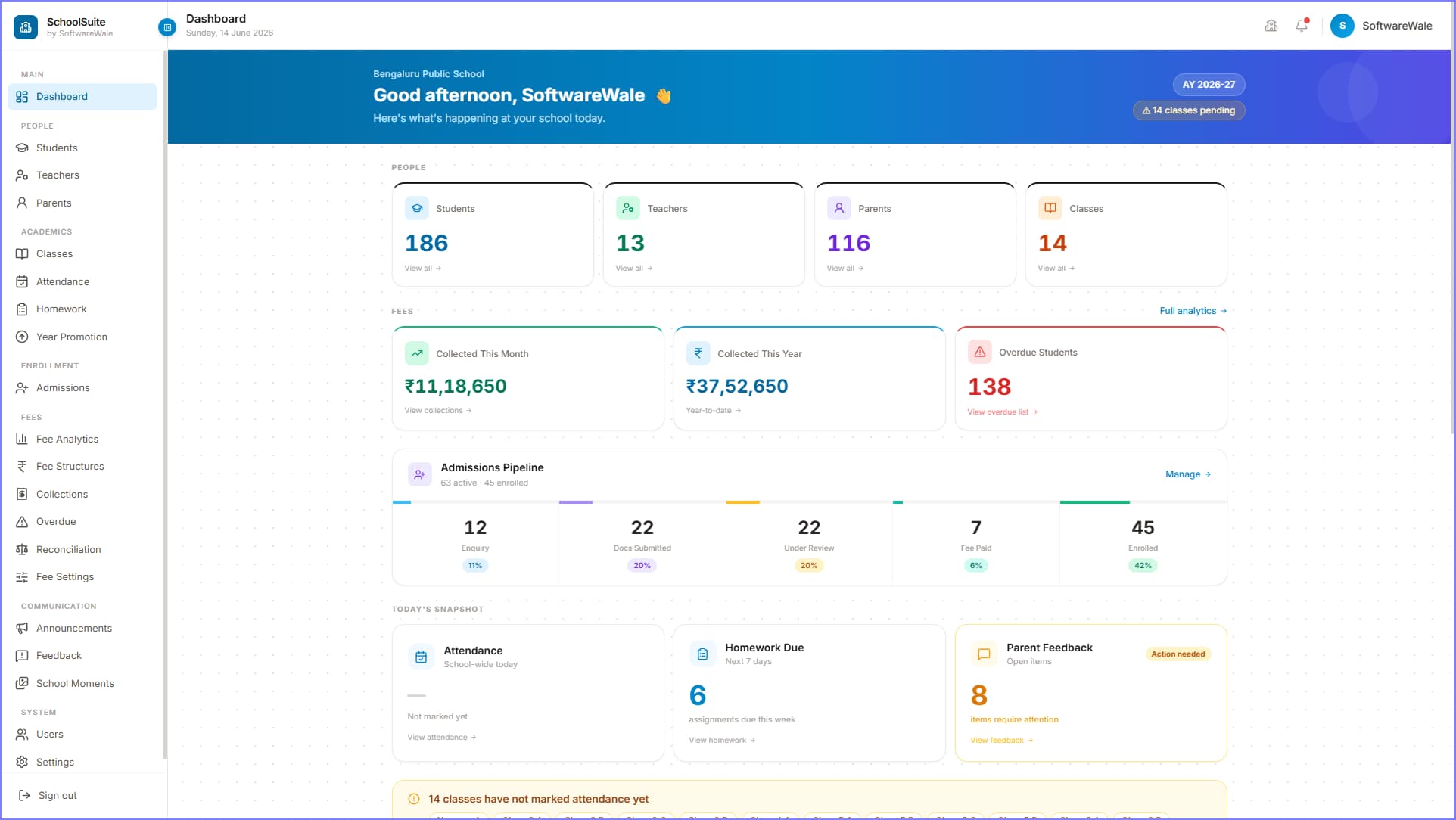
SchoolSuite admin panel — what you should see before committing to any school management software.
Five Questions to Ask Every Vendor Before Signing
1. “Can I see the system running on my own school’s data before I pay?”
Any serious vendor will say yes. A trial on your actual school data — your classes, your students, your fees — tells you things a demo video never will. How easy is it for your teachers to mark attendance? Do parents download and use the app? If a vendor refuses or delays a trial, that is a red flag.
2. “Who owns our school data, and what happens if we stop using the software?”
Your student records, attendance history, fee data, and parent contacts belong to your school. If a vendor cannot tell you clearly how you get your data back in a usable format like Excel or CSV, walk away. Data lock-in is a real risk.
3. “What does setup actually involve, and who does the work?”
Some platforms give you login credentials and a manual, and you figure it out. For most Indian schools without dedicated IT staff, this means the software never gets properly configured. Setup should be handled by the vendor — who imports your data, creates the class structure, trains your teachers — not left to your office staff.
4. “Does the app work when internet is weak or unavailable?”
In many Indian schools — particularly in Tier-2 cities and states like Assam, Uttar Pradesh, and Jharkhand — internet connectivity is inconsistent. A teacher in a classroom with poor signal should still be able to mark attendance. If the software requires constant internet to function, your teachers will face problems every other day and eventually stop using it.
5. “What does support look like after we go live?”
Many vendors are extremely attentive before you sign and very slow to respond after you pay. Ask for the specific support channel and typical response times. For an Indian school, WhatsApp-based support from a real person is far more practical than raising a ticket and waiting 48 hours.
Red Flags to Watch Out For
The “unlimited features” pitch
A vendor who leads with “we have 200 modules” is often trying to impress you with complexity. Most schools use 5-6 features daily: attendance, homework, fees, announcements, teacher app, and parent app. Ask to see only the features your school will actually use. If the core daily workflow is not simple, nothing else matters.
No live demonstration
Be careful of vendors who only share brochures, screenshots, or recorded videos. Insist on a live walkthrough where you can ask questions in real time. A live demo on a video call tells you far more than a polished presentation — including how responsive the vendor is and whether they understand Indian school workflows.
Long commitment with large upfront fees
Some vendors charge large setup fees and lock you into 2-3 year contracts. For a school trying software for the first time, this is a significant financial risk. A vendor confident in their product should not need to lock you in for years. Start with a short commitment and renew once you are satisfied.
What Indian Schools Specifically Need
A lot of school software sold in India was built for a different market and then adapted. The adaptation is usually surface-level: rupee currency, Hindi language option, maybe an Indian calendar. But the underlying assumptions about how schools work are different.
Indian parents are heavily phone-dependent. Most parents in Tier-2 and Tier-3 cities use Android phones. The parent app must work well on mid-range Android devices — not just flagship phones. If the app is slow or crashes on a Rs.10,000 phone, most of your parents will uninstall it within a week.
Indian schools also have specific fee workflows. Fees are collected by term, sometimes monthly, sometimes quarterly. Many schools allow installments. Fee categories differ — tuition, transport, library, lab, sports. The software must handle Indian fee structures, not just a simple monthly subscription model.
Finally, Indian teachers need software that requires minimal training. If it takes a full day of training to learn how to mark attendance, you will face resistance. The best school apps are designed so a teacher who uses WhatsApp daily can figure out the basic workflow without any formal training.
What Most Schools Regret Not Checking
After speaking with schools that have switched platforms — sometimes twice — three regrets come up consistently.
Not testing with actual teachers before buying.The principal demos the software and it looks fine. But when the teachers try it, half struggle and the rest lose interest within a week. Always test with two or three of your teachers during the trial. Their feedback matters more than the principal’s first impression.
Not asking about data migration.Schools have years of student records. If the vendor cannot import your existing data, you start from scratch or manually re-enter everything. Data migration should be the vendor’s responsibility.
Choosing based on price alone. The cheapest option is often cheap for a reason. If the platform has a poor parent app, no offline support, and slow customer service, the low monthly cost will be offset by daily frustration and the eventual cost of switching again.
SchoolSuite offers a free 2-week pilot on your actual school data — no commitment, no payment. See it working in your school before you decide.
Book a Demo Call →A Simple Checklist Before You Decide
Before finalising any school management software, run through this:
Did I see the software live — not just screenshots or a recorded demo?
Did two or three of my teachers actually try using it?
Did a parent download and use the parent app on their own phone?
Is the pricing per-student or flat? What happens as enrolment grows?
Will the vendor migrate our existing student and fee data at no extra charge?
Does the app work with poor or no internet connection?
Is WhatsApp or phone support available, and how fast do they respond?
Can I get my data back in Excel or CSV if I stop using the software?
Is there a short trial or pilot period before a long-term commitment?
If you can check all nine, you have done your homework properly. If a vendor cannot satisfy even half of these, take more time before committing.
Choosing school management software is a multi-year decision. A good platform saves your staff hours every week, collects fees more reliably, keeps parents better informed, and makes your school look more professional.
Take the time to do this right. Your school and your teachers will feel the difference for years.
Keep reading
- What per-student pricing actually costs as your school grows — the arithmetic, and the six questions to ask any vendor.
- Automatic timetable generation for schools — how a clash-free timetable gets built in minutes rather than days.
- Everything SchoolSuite includes — attendance, fees, exams, parent and teacher apps.